Buildable feasibility in seconds,
not hours.
GridFox turns any Toronto address into a complete laneway- and garden-suite feasibility — lot, house, buildable envelope, setbacks, fire-service route, and a print-ready PDF report. CAD-accurate. Bylaw-coded. No AI.
Feasibility work is slow, risky, or both.
Three failure modes have stopped small firms from scaling their feasibility output. GridFox closes all three.
Manual CAD feasibility takes hours
Locate the parcel, measure the lot, apply setbacks, check the 7.5 m separation, plot the fire route, format the PDF. Three to four hours of senior time, per address.
AI-built tools hallucinate
An LLM-generated envelope is a liability — outputs you can't defend in front of a planning committee, and that won't survive a legal challenge if a build goes wrong.
Generic GIS doesn't know Toronto
ZBL 569-2013, garden-suite rules, fire-service routing — every output from a generic tool still needs a human pass. Which means you're paying for the human anyway.
From an address to a report, in under a second.
Type any Toronto address. GridFox locates the parcel in your CAD library, extracts the lot, house and garage, computes the buildable envelope, plots the fire-service route, and lets you download a print-ready PDF.
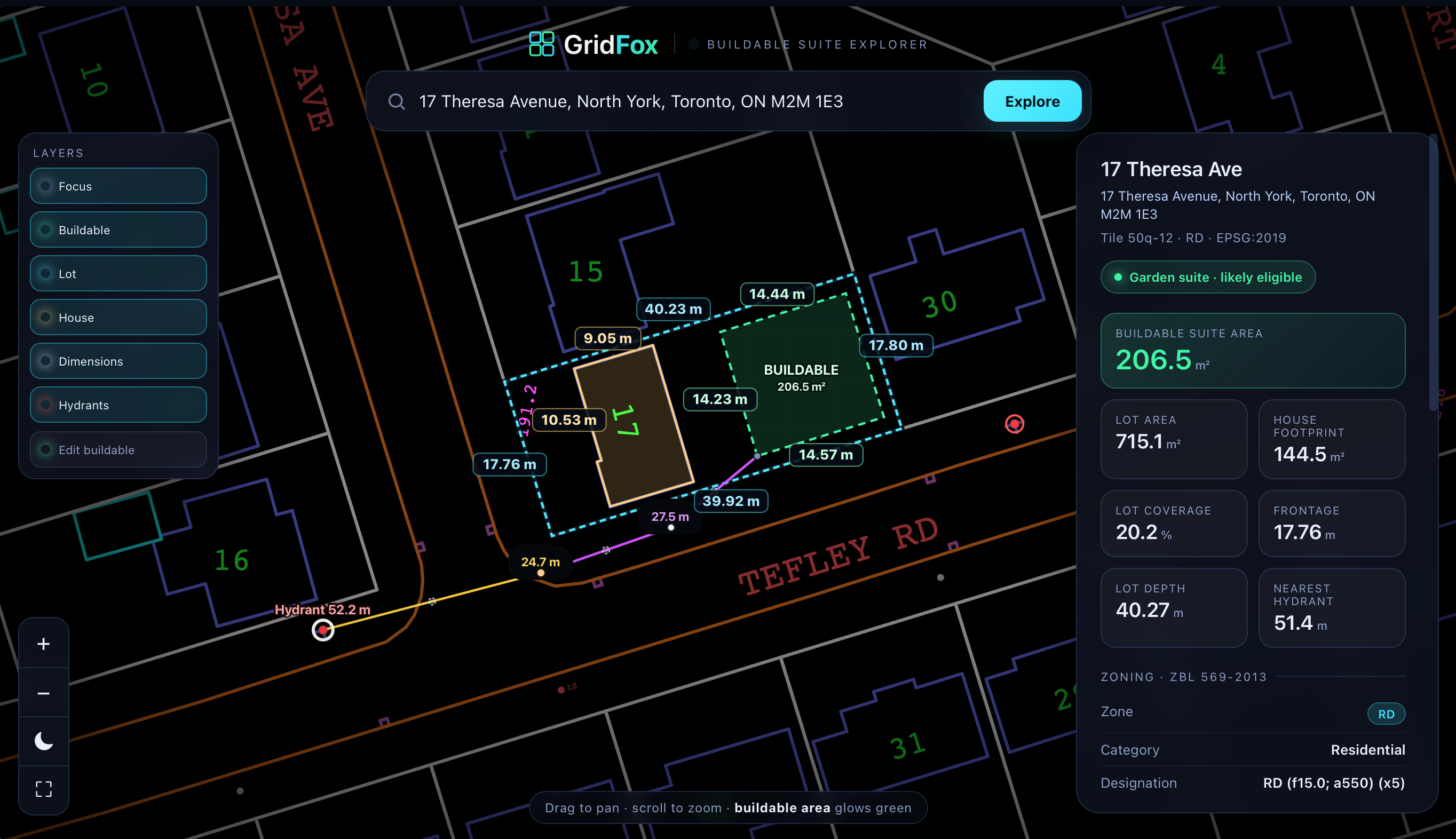
Setbacks
Front, side, rear — computed against ZBL 569-2013 and the parcel geometry.
Buildable envelope
Solved against lot boundary, house wall, and the 7.5 m rear separation rule.
Fire-service route
Nearest hydrant within bylaw distance, with a two-leg path drawn on the map.
Zoning ZBL 569-2013
Bylaw attributes surfaced per parcel — no PDF-hunting required.
Editable on map
Drag corners, add edge points, watch dimensions update live as you iterate.
PDF report
Print-ready, brandable, generated on demand — no template wrangling.
The market tried AI. It didn't work.
Buildable envelopes, setbacks, and fire-route calculations don't tolerate the variance an LLM introduces. Competitors who tried the AI route couldn't reach the accuracy a planning meeting demands. GridFox is engineered, not generated.
Defensible by design
Every output is reproducible. The same address yields the same envelope, every time — usable in planning submissions and in front of legal counsel.
Zero operational cost
No AI tokens. No API bills. No model deprecations. The marginal cost of running a report is effectively zero, forever.
No hallucinations
Geometry comes from your CAD library. Rules come from the bylaw. The system has no creative liberty — which is the whole point.
928 tiles. Every Toronto parcel.
GridFox ships with a complete tile index of the City of Toronto. Type any address inside the city — it resolves to the right tile, the right parcel, every time. More municipalities are coming.
Built for small teams. Scaled like a big one.
GridFox replaces a workflow that used to require a senior CAD technician. The operator just types an address — no specialist training required.
Feasibility before the client meeting
Quote on a property with the buildable envelope already drawn. No more 'we'll come back to you after a site visit.'
Assess sites in seconds, not days
Run a dozen candidate properties in the time it takes to make coffee. Buy or pass with real data, not gut feel.
Quote buildability with confidence
Sell laneway-suite potential as part of the listing. Defensible numbers your buyers can take to their architect.
Three steps. No sales theatre.
Request access
Two-minute form. Tell us a bit about your work.
Receive a secure demo link
We grant a time-limited link to the live tool — no install.
Buy or licence
Own it outright, or run it as a hosted service. Your call.
Questions we get often.
Parcel geometry comes from your CAD library and is refreshed when you update the tiles. Address resolution uses OpenStreetMap (live, free). Zoning attributes are encoded against the current Toronto bylaw revision.
Skip the three-hour CAD report. Start with one address.
Two minutes to request access. Try GridFox on properties you already know — see what your feasibility workflow looks like at a different speed.